C Program For Insertion And Deletion In Bst
How can I create/delete a node in a Binary Search Tree using Iterative Algorithm in C?
4 Answers
The following is definition of Binary Search Tree(BST) according to Wikipedia Binary Search Tree, is a node-based binary tree data structure which has the following properties: The left subtree of a node contains only nodes with keys lesser than the node’s key. The right subtree of a node contains. Find more on Program to insert and delete a node from the binary search tree Or get search suggestion and latest updates. Alice Miller author of Program to insert and delete a node from the binary search tree is from Frankfurt, Germany.
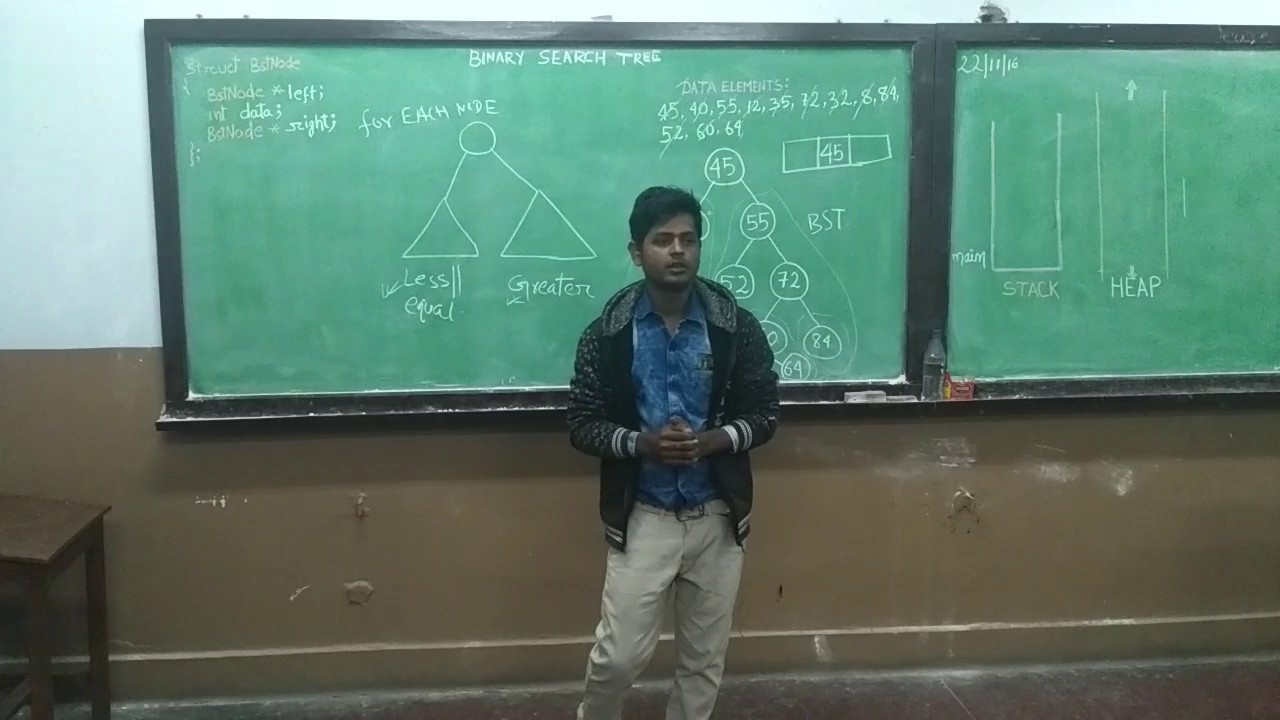
In this tutorial we will see what is binary search tree, binary search tree definition, c program for binary search tree. Binary search tree definition. Binary search tree (BST) is a binary tree in which each node has value greater than every node of left sub tree and less than every node of right subtree. Binary search tree complexity: O(log N). Binary Search Tree Operations using C++. Binary Search Tree Operations Insert, Delete and Search using C++. C++ Program to Perform Insertion and Deletion Operations on AVL-Trees. C++ Program to Print Numbers in Ascending Order Using Merge Sort. Depth First Search (DFS) Implementation using C++. Data Structures and Algorithms Binary Search Tree - Learn Data Structures and Algorithm using c, C++ and Java in simple and easy steps starting from basic to advanced concepts with examples including Overview, Environment Setup, Algorithm, Asymptotic Analysis, Greedy Algorithms, Divide and Conquer, Dynamic Programming, Data Structures, Array. Insertion & Deletion in a Binary Search Tree Using C# This articles describes the algorithm to insert and delete elements in a Binary Search Tree (BST) and it's implementation in C#. Prakash Tripathi.
Nice post. Just a suggestion. I believe, finding a minimum value in a BST doesn't have to traverse the right subtree. Minimum value must be either on the left subtree or node itself(in case if left subtree is null). Function find_minimum_value can be optimized if right subtree traversal is removed.
In C, you can cast the pointers in the tree to intptr_t type and perform bitwise operations to them.
As you traverse down the tree, you can store the 'parent' pointer of a node by xoring it with the pointer you traversed with. You can then traverse back up the tree by xoring the the address of the node you are coming from with the modified pointer.
A worked example of this traditional technique is at http://sites.google.com/site/debforit/efficient-binary-tree-traversal-with-two-pointers
Given the ability to traverse the tree without recursion, you can then create iterative versions of any of the algorithms based on traversing the tree.
Pete KirkhamPete KirkhamNot the answer you're looking for? Browse other questions tagged cbinary-tree or ask your own question.
C Program to Implement Binary Search Tree Traversal
PoojaC Program to implement Binary Search Tree Traversal
2 4 6 | (root,left,right) (left,root,right) (left,right,root) |
Reference :http://en.wikipedia.org/wiki/Tree_traversal
Skilled Ist class Skilled IInd class Unskilled Labour charges can be obtained from Schedule of Rates. • Labour: May be classified into three types. To revise the schedule of rates due to increase in the cost of material and labour or due to change in technique. Building and engineering contracts by b s patil pdf merge. Lead Statement:The distance between the source of availability of material and construction site is known as Lead and is calculated in km.The conveyance cost of material depends on lead The lead statement will give the total cost of materials per unit item including first cost, conveyance loading-unloading, stacking charges etc. 30% of the skilled labour in data should be taken as Ist class and remaining 70% as IInd class.
Program :2 4 6 8 10 12 14 16 18 20 22 24 26 28 30 32 34 36 38 40 42 44 46 48 50 52 54 56 58 60 62 64 66 68 70 72 74 76 78 80 82 84 86 88 90 92 94 96 98 100 102 104 106 108 110 112 114 116 118 120 122 124 126 128 130 132 134 136 138 140 142 144 146 148 150 152 | # include <conio.h> intdata; }node; voidinsert(node *,node *); voidpreorder(node *); node *search(node *,int,node **); voidmain(){ charans='N'; node *new_node,*root,*tmp,*parent; root=NULL; do{ printf('n2.Search'); printf('n4.Exit'); scanf('%d',&choice); switch(choice){ do{ printf('nEnter The Element '); root=new_node; insert(root,new_node); printf('nWant To enter More Elements?(y/n)'); }while(ans'y'); printf('nEnter Element to be searched :'); printf('nParent of node %d is %d',tmp->data,parent->data); if(rootNULL) else{ inorder(root); preorder(root); postorder(root); break; }while(choice!=4); /* */ node *temp; temp->lchild=NULL; returntemp; /* This function is for creating a binary search tree voidinsert(node *root,node *new_node){ if(root->lchildNULL) else } if(new_node->data>root->data){ root->rchild=new_node; insert(root->rchild,new_node); } This function is for searching the node from */ node *temp; while(temp!=NULL){ printf('nThe %d Element is Present',temp->data); } temp=temp->lchild; temp=temp->rchild; returnNULL; /* This function displays the tree in inorder fashion voidinorder(node *temp){ inorder(temp->lchild); inorder(temp->rchild); } This function displays the tree in preorder fashion voidpreorder(node *temp){ printf('%d',temp->data); preorder(temp->rchild); } /* This function displays the tree in postorder fashion voidpostorder(node *temp){ postorder(temp->lchild); printf('%d',temp->data); } |
Explanation :
- get_node() function will allocate memory dynamically and allocate one node.
- if below condition is satisfied then we can say that we are going to create first node of the tree. (i.e Tree is empty and this created node is very first node)
- If condition does not satisfied then we can say that we have already node in a tree. (i.e this node which we have created is not a first node)
Display Tree
To display tree we have 3 traversal Techniques –
- In-Order Traversal
- Pre-Order Traversal
- Post-Order Traversal
Algorithm for Preorder Traversal of Binary Search Tree :
2 4 6 8 10 | { then else Go toLeft Childof node } |
Similarly Post order and inorder traversal works.
Summary of Traversal of BST :
| Traversal Type | Inorder | Preorder | Postorder |
|---|---|---|---|
| Short Cut | L V R | V L R | L R V |